
Bitcoin is trading steadily near $118,900, showing little volatility on the surface. Yet beneath this calm price action, a major shift is unfolding. PayPal has rolled out a powerful update that could reshape how cryptocurrencies are used in everyday commerce. By allowing more than 400 million users to pay merchants with Bitcoin and over 100 other digital assets, PayPal may have triggered the next phase of Bitcoin’s journey toward mass adoption and a potential $250,000 valuation by 2025.
This move goes far beyond a routine app upgrade. It represents one of the strongest signals yet that crypto payments are moving from niche use cases into the global financial mainstream.
Read More: 3 Hidden Tech Gems Poised to Skyrocket — Must-Buy Stocks for Savvy Investors Today!
PayPal’s “Pay with Crypto” Initiative Explained
PayPal’s new “Pay with Crypto” feature enables U.S.-based merchants to accept cryptocurrency payments directly from popular wallets such as MetaMask, Coinbase, and Kraken. At checkout, the system instantly converts crypto into fiat currency or PayPal’s stablecoin, PYUSD, removing friction from the transaction process.
Related News



For merchants, the experience remains familiar. They receive dollars without worrying about crypto price swings. For consumers, it offers a seamless way to spend Bitcoin and other digital assets without needing complex workarounds. This structure eliminates one of the biggest barriers that has historically limited crypto adoption in retail environments.
By simplifying both sides of the transaction, PayPal has created a payment flow that feels practical, fast, and scalable.



Why This Changes the Crypto Payments Landscape
Crypto payments have long struggled with usability. Volatility, slow settlement times, and accounting complexity made most merchants hesitant to participate. PayPal’s integration tackles these issues head-on.
Merchants benefit from instant settlement, lower transaction costs, and the option to hold balances in PYUSD while earning up to 4% APY. Consumers gain flexibility and freedom, spending crypto without converting funds manually or navigating complex platforms.
This model allows Bitcoin to function less like “digital gold” and more like usable money. Instead of sitting idle in wallets, BTC can now circulate through real-world commerce at scale.
A Strategic Step Toward Global Expansion
What makes this development especially important is PayPal’s long-term vision. The company has confirmed plans to expand this initiative globally through an upcoming platform called PayPal World. This system is expected to serve as a global crypto settlement layer, enabling cross-border digital payments with minimal friction.



PayPal’s crypto journey began with custody services in 2020. The 2025 iteration marks a turning point by focusing on utility, merchant adoption, and ecosystem maturity. Rather than treating crypto as a speculative add-on, PayPal is embedding it directly into its core payments infrastructure.
This shift signals confidence not only in Bitcoin’s longevity but also in its role within the future of digital finance.
Bitcoin Price Action Remains Calm but Compressed
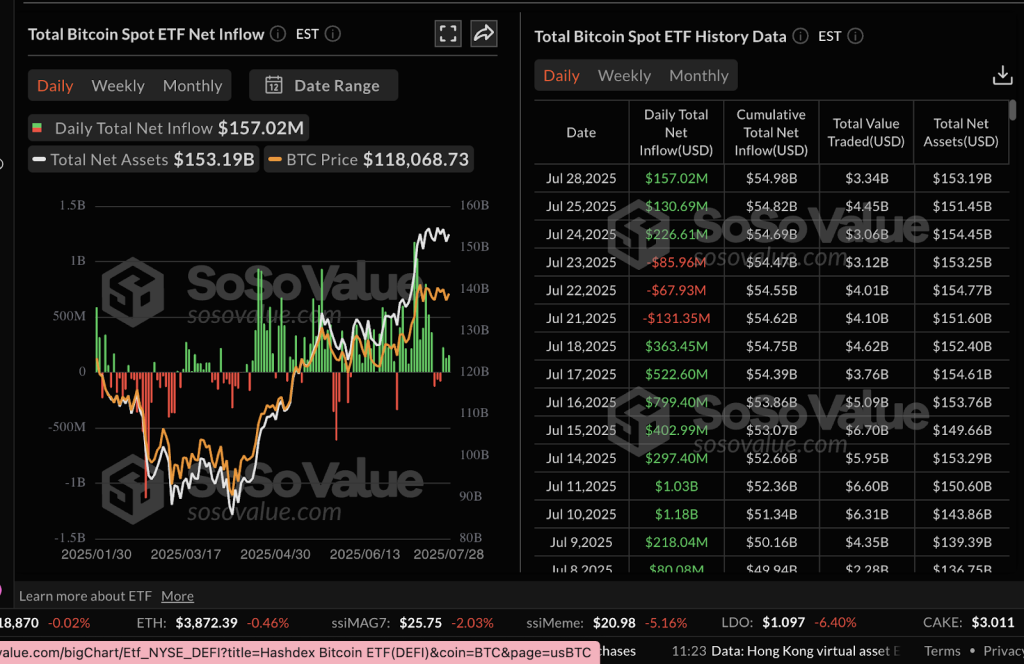
Despite the significance of the announcement, Bitcoin’s price has remained range-bound between $116,000 and $120,000. This lack of immediate reaction may surprise some investors, but market observers see it as a classic period of consolidation.
Compressed price ranges often precede sharp directional moves. Analysts suggest that Bitcoin is waiting for a broader liquidity catalyst before making its next major push. As global liquidity conditions improve, infrastructure upgrades like PayPal’s could amplify the impact.
The current pause may simply reflect patience rather than weakness.
Liquidity Trends Could Fuel the Next Rally
Liquidity has emerged as a recurring theme in Bitcoin forecasts. Rising global money supply and expanding financial conditions tend to favor risk assets, especially those with fixed supply like Bitcoin.
When improving liquidity aligns with real-world adoption, the results can be explosive. Payment platforms that onboard millions of users reduce friction and increase transactional demand. This combination strengthens Bitcoin’s supply-demand dynamics and supports higher long-term valuations.
With PayPal providing access at the consumer level, Bitcoin’s exposure to everyday economic activity continues to grow.
Macro Factors Supporting Market Stability
Broader macroeconomic developments are also influencing Bitcoin’s current stability. A recent trade agreement between the U.S. and the EU reduced pending tariffs, easing pressure on global markets. While the new tariff levels remain elevated, the de-escalation improved overall investor sentiment.
At the same time, traders remain cautious ahead of the U.S. Federal Reserve’s upcoming interest rate decision. This wait-and-see approach has limited aggressive positioning across both equities and crypto, contributing to Bitcoin’s sideways movement.
Once macro uncertainty clears, markets may be better positioned to react to bullish catalysts.
Technical Outlook Signals a Breakout Ahead
From a technical perspective, Bitcoin is forming a symmetrical triangle pattern, often associated with continuation moves. Resistance sits near $121,100, while strong support has formed around $117,400.
The 50-day simple moving average lies just below current price levels, suggesting underlying bullish momentum. Meanwhile, the Relative Strength Index (RSI) hovers in neutral territory, indicating neither overbought nor oversold conditions.
A confirmed breakout above resistance could open the door to a rally toward $125,600. A breakdown below support may trigger a short-term pullback. Either scenario points to increased volatility ahead.
PayPal as the Catalyst Bitcoin Needed
The key question remains whether PayPal’s integration can act as the catalyst that breaks Bitcoin out of its consolidation phase. The answer may lie in adoption speed.
Millions of users can now spend crypto in everyday transactions, while merchants gain tools that eliminate complexity. This alignment of incentives strengthens Bitcoin’s case as a functional payment asset rather than a passive store of value.
As usage grows, transaction volume and network relevance increase, reinforcing long-term bullish narratives.
Bitcoin’s Path Toward $250,000 by 2025
Several analysts believe Bitcoin has a credible path to $250,000 by late 2025. The thesis rests on three pillars: expanding liquidity, rising institutional confidence, and accelerating consumer adoption.
If payment networks like PayPal and apps like Venmo continue integrating crypto at scale, Bitcoin’s addressable market expands dramatically. With a fixed supply and increasing demand, upward price pressure becomes difficult to ignore.
The shift from speculation to utility could redefine how investors value Bitcoin in the years ahead.
Bitcoin Hyper Emerges as a Layer 2 Contender
Beyond payments, innovation within the Bitcoin ecosystem continues. Bitcoin Hyper ($HYPER) is gaining attention as a Bitcoin-native Layer 2 solution powered by Solana’s virtual machine. The project aims to combine Bitcoin’s security with high-speed, low-cost smart contract functionality.
The presale has already raised over $5.7 million, with features that include fast transactions, decentralized applications, and meme coin creation. As interest in scalable Bitcoin solutions grows, Layer 2 projects like Bitcoin Hyper are drawing increased scrutiny from investors.
This expansion adds another layer of utility to the broader Bitcoin narrative.
Bitcoin’s Narrative Is Rapidly Evolving
Bitcoin is no longer confined to a single identity. It is evolving from a hedge against inflation into programmable money with real-world applications. Payment integration, Layer 2 development, and global settlement infrastructure are reshaping how users and institutions interact with the network.
PayPal’s move represents a powerful endorsement of this transformation. By bridging crypto with mainstream commerce, it accelerates Bitcoin’s transition into daily financial life.
If adoption continues at this pace, Bitcoin’s next breakout may extend far beyond current resistance levels. The road to $250,000 is no longer just theoretical. Momentum is building, and the foundation is taking shape.
Frequently Asked Questions:
What does PayPal’s crypto integration mean for Bitcoin?
PayPal’s integration allows millions of users to spend Bitcoin directly with merchants, making crypto payments simpler and more accessible. This move strengthens Bitcoin’s real-world utility and supports broader adoption beyond investing.
How does PayPal enable Bitcoin payments?
PayPal enables users to pay with Bitcoin through supported crypto wallets, while merchants receive fiat currency or stablecoins instantly. This removes volatility concerns for businesses and simplifies checkout for consumers.
Why is PayPal’s move considered a major adoption milestone?
PayPal serves over 400 million users globally. Its decision to support crypto payments signals institutional confidence and brings Bitcoin closer to mainstream financial systems.
Can PayPal’s crypto payments impact Bitcoin’s price?
Increased adoption and real-world usage can boost demand for Bitcoin. Combined with limited supply, this growing demand may contribute to upward price momentum over time.
Why are analysts predicting Bitcoin could reach $250,000 by 2025?
Price forecasts are based on rising global liquidity, institutional participation, expanding payment infrastructure, and Bitcoin’s fixed supply. Payment platforms like PayPal amplify these factors by driving consumer-level demand.
Is Bitcoin currently showing bullish price signals?
Bitcoin is trading within a tight range, often seen before major breakouts. Technical indicators suggest growing momentum, even though the price has not yet reacted strongly to recent developments.
What role does global liquidity play in Bitcoin’s outlook?
Higher liquidity typically supports risk assets such as Bitcoin. When liquidity growth aligns with adoption and infrastructure upgrades, it can accelerate price appreciation.
Conclusion
Bitcoin stands at a pivotal moment as mainstream adoption accelerates and real-world use cases expand. PayPal’s decision to open its payment network to cryptocurrencies marks a powerful step toward integrating Bitcoin into everyday commerce. By removing friction for both consumers and merchants, this move strengthens Bitcoin’s utility and reinforces its long-term value proposition. While price action remains calm for now, underlying fundamentals continue to improve. Growing liquidity, increasing institutional confidence, and expanding payment infrastructure are aligning in Bitcoin’s favor. These forces suggest that the current consolidation phase may be setting the stage for a much larger move.