
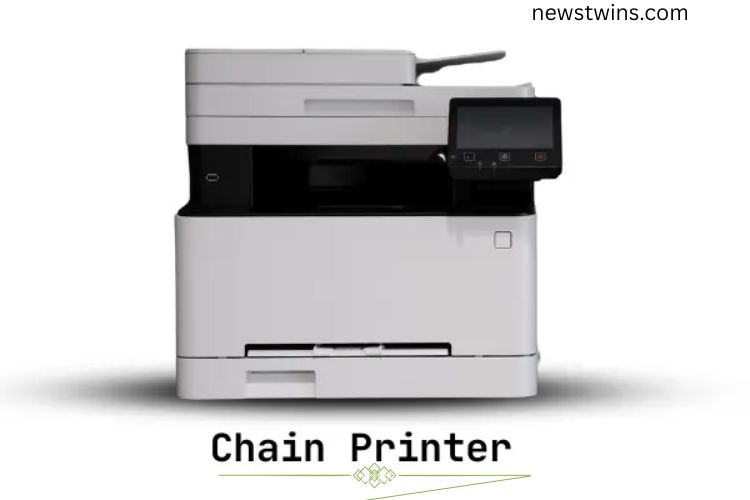
Did you know that chain printers were once the backbone of high-speed printing in banks, government offices, and large enterprises? Capable of printing up to 1,200 lines per minute, these machines were some of the fastest impact printers of their time. While modern laser and inkjet printers dominate today’s market, chain printers were essential in an era when speed, reliability, and bulk printing were critical.
In this article, we explore what chain printers are, how they work, their uses, advantages, disadvantages, and key components—all in simple terms for beginners and enthusiasts alike.
Read More: Unlock the Ultimate Laptop Guide: Discover Every Type of Computer for Beginners!
What is a Chain Printer?
A chain printer is a type of line printer that uses a rotating metal chain embedded with characters to print text. As the chain spins rapidly, hammers strike the paper through an inked ribbon, transferring characters onto the page. This mechanism allows the printer to produce an entire line of text simultaneously, making it significantly faster than older drum or dot matrix printers.

These printers were particularly common in banks, government offices, and businesses that required high-volume printing. Known for their durability and cost-effectiveness, chain printers excelled in printing text-heavy documents, though they were noisy and unable to print graphics.
How Does a Chain Printer Work?
The operation of a chain printer is fascinating in its simplicity and efficiency. It relies on a metal chain with embossed characters that spins in front of the printing area. Small hammers strike the paper through an inked ribbon whenever the correct character passes, printing an entire line in a single pass.
Step-by-Step Printing Process
Step 1: Chain Movement & Hammer Activation
The metal chain spins at high speed, moving characters in front of the printing zone. When the correct character aligns, a hammer strikes the paper, pressing the ink from the ribbon onto the page.
Step 2: Ink Transfer & Paper Advancement
The inked ribbon sits between the hammer and the paper. When hit, it transfers the ink, forming clear, crisp letters. After printing one line, the paper advances, and the process repeats until the document is complete.
This combination of speed and precision allowed chain printers to handle massive volumes of text far faster than competing technologies of their time.
Common Uses of Chain Printers
Chain printers were designed for high-volume, text-based printing, making them ideal for industries where speed and efficiency mattered most.
Key Applications:
- Bank Statements – Printed hundreds of statements quickly for customers.
- Office Reports – Generated invoices, memos, and documents efficiently.
- Government Records – Produced bulk official documents like forms and notices.
- Inventory & Accounting – Managed financial records and stock lists with speed.
- Shipping Labels – Printed labels in warehouses for logistics operations.
- Bulk Mailings – Ideal for newsletters, promotional letters, and mass communication.
- Tax Records – Helped government agencies print forms and records reliably.
- Production Reports – Manufacturing plants used them for daily and weekly reports.
- Large-scale Newsletters – Media organizations printed hundreds of newsletters efficiently.
- Payroll Slips – Companies distributed employee payroll information quickly.
Advantages and Disadvantages
Like any technology, chain printers offered specific benefits but also had limitations. Understanding these helps explain why they were widely used in the past but have largely been replaced today.
Advantages
- High-Speed Printing – Capable of printing entire lines at once.
- Large Volume Output – Ideal for bulk printing needs.
- Durable & Reliable – Long lifespan with consistent performance.
- Cost-Effective – Efficient for text-based printing over extended periods.
- Simple Design – Easy to maintain compared to other complex systems.
- Reduced Paper Waste – Efficient line-by-line printing minimizes errors.
Disadvantages
- No Graphics – Limited to text; cannot handle images.
- Noisy Operation – Impact printing generates considerable sound.
- Bulky and Heavy – Requires significant space in offices.
- Slower Than Modern Printers – Outpaced by lasers and inkjets today.
- Limited Color Printing – Typically monochrome only.
- High Maintenance – Requires periodic ribbon replacement and hammer servicing.
- Energy Consumption – Less energy-efficient compared to modern printers.
- Paper Limitations – Cannot print on glossy or specialty media.
Key Components of a Chain Printer
Understanding the structure of a chain printer highlights how engineering achieved such high-speed output.
- Metal Chain – Holds characters and rotates rapidly in front of the printing zone.
- Hammers – Strike the paper through the inked ribbon to print characters.
- Inked Ribbon – Transfers ink to the paper when hit by the hammers.
- Printing Head – Supports the hammers and aligns them for precise printing.
- Paper Feed – Moves the paper line by line for continuous printing.
- Motor – Powers both the chain and the paper feed system.
- Control Unit – Coordinates the timing of chain movement and hammer strikes.
- Frame – Provides structural support for all components.
- Power Supply – Delivers the required energy for operation.
- Switches & Buttons – Control power, operation modes, and settings.
Frequently Asked Questions:
What is a chain printer?
A chain printer is a high-speed line printer that uses a rotating metal chain with characters. Hammers strike the paper through an inked ribbon to print entire lines at once, making it faster than traditional printers.
How does a chain printer work?
The printer spins a metal chain with letters and numbers. When the correct character aligns, a hammer hits the paper through an inked ribbon, transferring the ink. This prints one full line at a time.
Where were chain printers commonly used?
They were widely used in banks, government offices, large businesses, and manufacturing plants—anywhere bulk, high-speed text printing was needed.
Can chain printers print graphics or images?
No, chain printers are designed for text-based printing only. They cannot print images, graphics, or color documents.
What are the main advantages of chain printers?
Chain printers are fast, durable, cost-effective, and ideal for large-volume printing. They are simple to maintain and have a long lifespan for text-heavy jobs.
What are the disadvantages of chain printers?
They are noisy, bulky, energy-intensive, and limited to text. Modern printers outperform them in speed, graphics, and versatility.
Are chain printers still in use today?
Mostly no. Modern laser and inkjet printers have replaced them in most offices due to their quieter operation, better graphics capabilities, and compact design.
Conclusion
Chain printers were once the powerhouses of high-speed, bulk printing, serving banks, government offices, and large businesses with remarkable efficiency. By printing entire lines at once, they combined speed, durability, and cost-effectiveness, making them essential in an era before modern laser and inkjet technology. Although they have largely been replaced by quieter, more versatile printers today, understanding how chain printers work, their uses, advantages, and components provides valuable insight into the evolution of printing technology. For beginners and enthusiasts, chain printers are a perfect example of ingenious engineering designed to meet demanding printing needs—a testament to how technology continues to transform the way we handle information.