


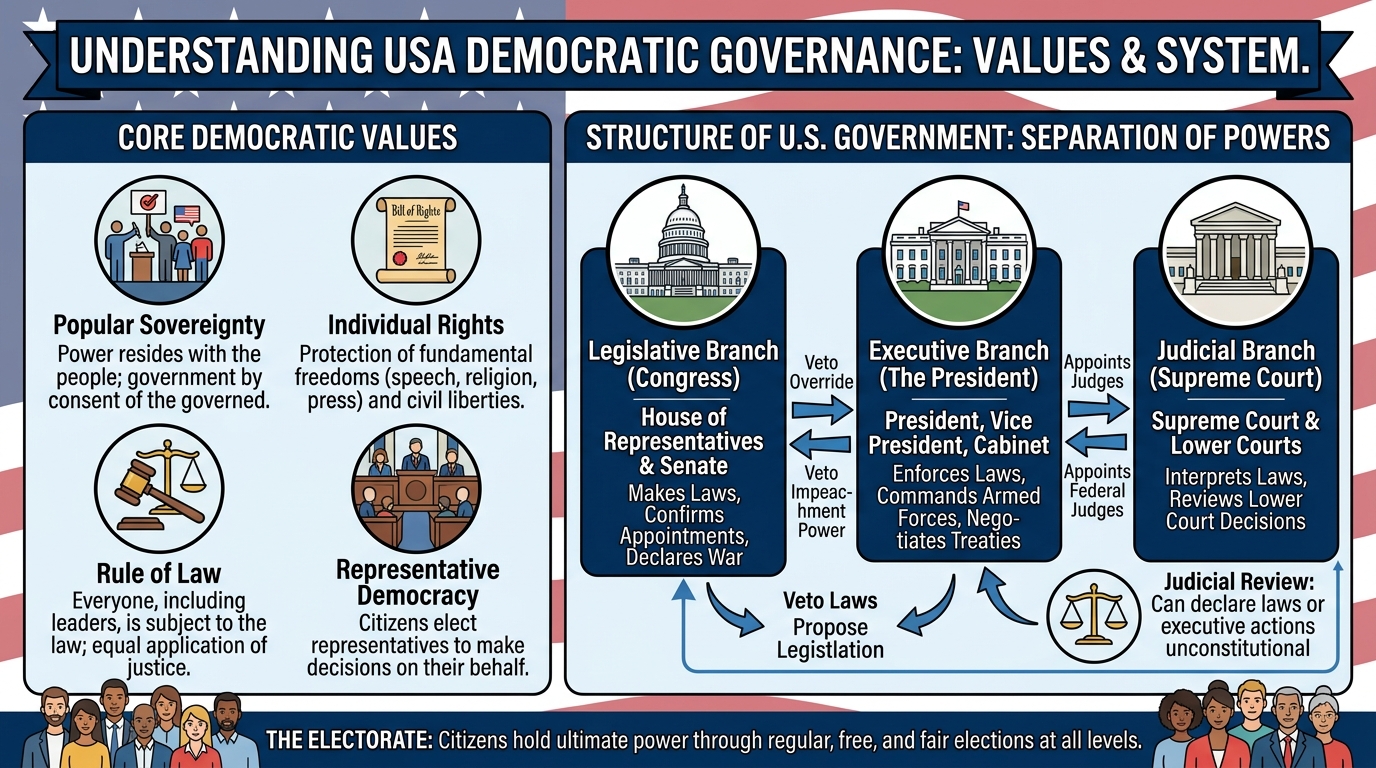
Democratic values and the governance system in the United States are built on principles of freedom, equality, rule of law, and citizen participation. The U.S. operates as a federal constitutional republic where power is divided between national and state governments, ensuring balance and accountability. Its democratic framework is designed to protect individual rights while maintaining stable governance through checks and balances across different branches of power. Understanding this system helps explain how the United States maintains political stability and citizen representation in a diverse society.
Constitutional Foundation Of Democracy
U.S. Constitution Framework
The U.S. Constitution is the supreme law of the land and establishes the structure of government. It defines the separation of powers, limits authority, and protects fundamental rights. This framework ensures that no branch becomes too powerful, maintaining democratic stability and legal order.
Bill Of Rights Protection
The Bill of Rights guarantees essential freedoms such as speech, religion, and assembly. These rights protect citizens from government overreach and ensure individual liberty. It plays a central role in maintaining democratic values in everyday life.
Amendment System Flexibility
The amendment process allows the Constitution to evolve with changing times. This flexibility ensures that democratic principles remain relevant. It reflects the adaptability of the U.S. governance system.
Federal Structure Division
The U.S. is a federal system where power is shared between national and state governments. This division allows regional autonomy while maintaining national unity. It supports balanced governance across diverse regions.
Rule Of Law Principle
The rule of law ensures that all citizens and leaders are subject to the law equally. It prevents abuse of power and guarantees fairness. This principle is essential for maintaining justice in democracy.
| Constitutional Element | Function | Democratic Impact |
|---|---|---|
| Constitution | Governance structure | Legal stability |
| Bill of Rights | Civil freedoms | Individual protection |
| Federal system | Power division | Balanced authority |
Separation Of Powers System
Executive Branch Role
The President leads the executive branch and enforces laws. This branch manages national security, foreign policy, and government administration. It ensures effective implementation of laws passed by Congress.
Legislative Branch Function
Congress, consisting of the Senate and House of Representatives, creates laws. It represents the people and states in decision-making. This branch ensures democratic lawmaking and public representation.
Judicial Branch Authority
The Supreme Court and federal courts interpret laws and ensure they align with the Constitution. This judicial review maintains legal balance and protects citizens’ rights.
Checks And Balances System
Each branch has the power to limit the others, preventing misuse of authority. This system ensures accountability and protects democratic governance from concentration of power.
Independent Branch Operation
Each branch operates independently while cooperating with others. This separation ensures efficiency and prevents authoritarian control in governance.
Electoral System And Voting Rights
Presidential Election Process
The President is elected through an Electoral College system. Citizens vote for electors who represent their choice. This process balances population and state representation.
Congressional Elections Structure
Congress members are elected through direct voting. This ensures public representation at national and state levels. Elections strengthen democratic participation.
Voting Rights Protection Laws
Laws protect citizens’ right to vote regardless of race, gender, or background. These protections ensure fairness in elections and democratic inclusion.
Voter Participation Importance
High voter participation strengthens democracy and ensures representative leadership. Citizens’ involvement is essential for accountability.
Election Transparency Systems
Election monitoring and regulations ensure fair voting processes. Transparency builds trust in democratic outcomes.
Federalism And State Governance
State Government Powers
States have authority over education, transportation, and local laws. This allows tailored governance based on regional needs.
Local Government Functions
Local governments manage city services like policing, sanitation, and public infrastructure. They ensure grassroots governance.
Federal State Balance
Power is shared between federal and state governments. This balance prevents centralization and supports diversity in governance.
Interstate Cooperation Systems
States cooperate on shared issues such as trade and transportation. This improves national coordination and efficiency.
State Law Autonomy
States can create laws independently as long as they align with the Constitution. This ensures flexibility in governance.
Political Parties And Representation
Two Party System Structure
The U.S. primarily operates under a two-party system dominated by Democrats and Republicans. This system shapes national political competition.
Political Ideology Differences
Each party represents different political ideologies such as liberalism and conservatism. These differences guide policy decisions.
Election Campaign Strategies
Political campaigns use media, debates, and public engagement to gain voter support. Campaigns influence election outcomes.
Public Representation Roles
Elected officials represent citizens’ interests in government decisions. Representation ensures democratic accountability.
Party Influence On Policy
Political parties play a major role in shaping laws and national policies. They guide legislative priorities.
Civil Rights And Liberties
Freedom Of Speech Protection
Citizens have the right to express opinions freely. This strengthens democracy and public debate.
Religious Freedom Rights
Individuals can practice any religion without government interference. This ensures cultural diversity and tolerance.
Equal Protection Laws
Laws guarantee equal treatment under the legal system. This prevents discrimination and promotes fairness.
Civil Rights Movement Impact
Historical movements expanded rights for minorities and strengthened democracy. They shaped modern equality laws.
Privacy Rights Protection
Citizens have legal protection for personal privacy. This limits government surveillance and protects freedoms.
Media And Public Influence In Democracy
Free Press System
Independent media ensures transparency and informs citizens about government actions. It is essential for accountability.
Political Debate Coverage
Media platforms broadcast debates and political discussions. This helps citizens make informed decisions.
Public Opinion Formation
Media influences public perception of policies and leaders. It plays a key role in democracy.
Digital Media Expansion
Social media has increased political engagement and communication. It allows direct interaction between leaders and citizens.
Information Transparency Role
Access to information ensures government accountability and public awareness. Transparency strengthens democracy.
Challenges And Future Of U.S. Democracy
Political Polarization Issues
Increasing ideological divisions affect political cooperation. This creates challenges in governance and policy-making.
Electoral Reform Debates
Discussions continue about improving voting systems and representation. Reform aims to strengthen democracy.
Technology In Governance
Digital tools improve efficiency but also raise cybersecurity concerns. Technology shapes modern governance.
Civic Engagement Decline
Lower voter participation in some areas affects representation. Increasing engagement is a key priority.
Global Democratic Influence
The U.S. model influences democratic systems worldwide. Its evolution impacts global governance trends.
What are democratic values in the USA?
They include freedom, equality, rule of law, and citizen participation.
How does the U.S. government system work?
It operates as a federal system with three branches: executive, legislative, and judicial.
Why is the Constitution important?
It defines government structure and protects citizens’ rights.
What is the role of elections in the USA?
Elections allow citizens to choose representatives and leaders.
How does media support democracy?
Media provides information, ensures transparency, and encourages public debate.
Democratic values and governance in the United States are built on a strong constitutional foundation that balances power, protects individual rights, and ensures citizen participation. Through its system of checks and balances, federalism, and free elections, the U.S. maintains a stable yet adaptable democracy. While challenges exist, its institutional framework continues to shape modern democratic governance globally.
