


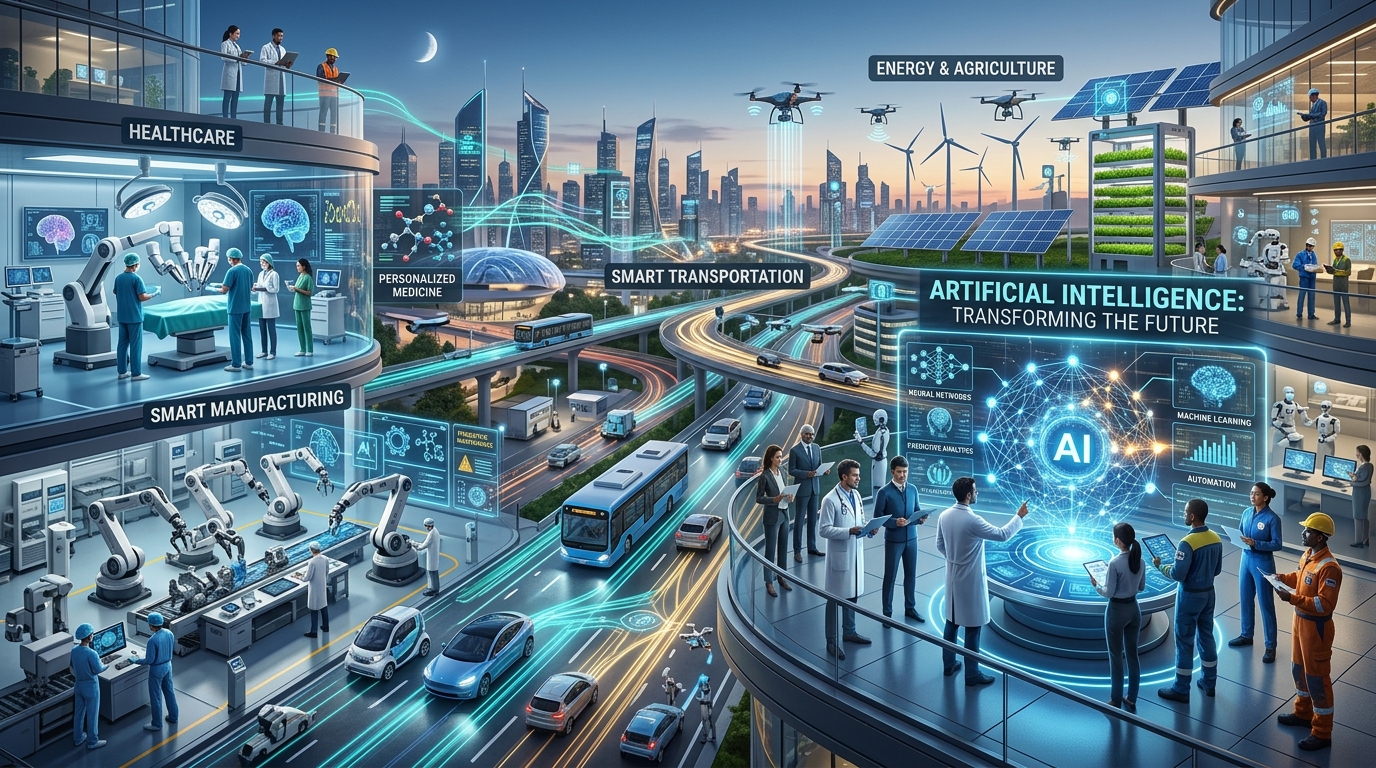
Artificial intelligence is rapidly transforming future technology and industries by changing how businesses operate, how decisions are made, and how services are delivered. From healthcare to finance, manufacturing to education, AI systems are enabling automation, improving accuracy, and unlocking new levels of productivity. This transformation is not just technological but also economic and social, as AI reshapes job roles, business models, and global competition in ways that were not possible before.
AI In Business Transformation
Automated Decision Making Systems
AI-powered systems analyze large datasets to support faster and more accurate decision-making in businesses. These systems reduce human error and improve operational efficiency. Companies use AI insights to optimize strategies and respond quickly to market changes.
Customer Experience Personalization
AI helps businesses personalize services based on customer behavior and preferences. This improves engagement, satisfaction, and loyalty. Personalized recommendations are widely used in e-commerce, streaming, and digital marketing.
Predictive Business Analytics
Predictive analytics uses AI to forecast market trends, customer demand, and business risks. This allows companies to plan better and reduce uncertainty. It enhances long-term strategic decision-making.
Process Automation Integration
AI automates repetitive tasks such as data entry, reporting, and customer support. This reduces costs and increases productivity. Businesses can focus more on innovation and growth.
Intelligent Supply Chain Management
AI improves supply chain efficiency by tracking inventory, predicting demand, and optimizing logistics. This reduces delays and operational costs while improving delivery accuracy.
| AI Application | Business Benefit | Industry Impact |
|---|---|---|
| Automation | Efficiency | Cost reduction |
| Analytics | Prediction | Better planning |
| Personalization | Engagement | Customer loyalty |
AI In Healthcare Innovation
Medical Diagnosis Assistance
AI systems assist doctors in diagnosing diseases using medical imaging and patient data. This improves accuracy and early detection of illnesses.
Drug Discovery Acceleration
AI speeds up the process of developing new medicines by analyzing chemical data. This reduces research time and costs significantly.
Patient Monitoring Systems
AI-powered devices continuously monitor patient health conditions. This helps in early intervention and better treatment outcomes.
Virtual Health Assistants
AI chatbots provide basic medical guidance and appointment scheduling. This improves accessibility to healthcare services.
Personalized Treatment Plans
AI analyzes patient history to create customized treatment strategies. This improves recovery rates and healthcare efficiency.
AI In Manufacturing And Industry
Smart Factory Automation
AI-driven factories use robotics and automation to increase production efficiency. This reduces human error and increases output quality.
Predictive Maintenance Systems
AI predicts machine failures before they occur. This reduces downtime and maintenance costs.
Quality Control Enhancement
AI systems detect defects in products during production. This ensures higher quality standards in manufacturing.
Robotics Integration Growth
Industrial robots perform complex tasks with precision and speed. This improves manufacturing consistency and safety.
Energy Efficiency Optimization
AI optimizes energy usage in factories, reducing waste and operational costs.
AI In Education Systems
Personalized Learning Platforms
AI adapts educational content based on student performance. This improves learning outcomes and engagement.
Virtual Classroom Assistance
AI supports online education through automated grading and tutoring systems. This enhances accessibility.
Skill Development Tracking
AI tracks student progress and identifies areas for improvement. This helps in better academic planning.
Language Learning Tools
AI-powered tools help users learn new languages through interactive methods. This improves communication skills.
Education Accessibility Expansion
AI makes education more accessible to remote and underserved regions through digital platforms.
AI In Transportation And Mobility
Autonomous Vehicle Technology
Self-driving vehicles use AI to navigate roads safely. This reduces accidents and improves transportation efficiency.
Traffic Management Systems
AI analyzes traffic patterns to reduce congestion and improve flow in cities.
Route Optimization Tools
AI calculates the fastest and most efficient travel routes. This saves time and fuel consumption.
Smart Logistics Solutions
AI improves delivery systems by optimizing routes and schedules for transportation companies.
Public Transport Efficiency
AI enhances scheduling and management of buses and trains for better commuter experience.
AI In Finance And Banking
Fraud Detection Systems
AI detects suspicious transactions and prevents financial fraud. This improves security in banking systems.
Algorithmic Trading Platforms
AI analyzes market data to execute trades automatically. This increases investment efficiency.
Credit Risk Assessment
AI evaluates customer creditworthiness using data analysis. This reduces financial risk for banks.
Customer Banking Chatbots
AI chatbots provide instant banking support and improve customer service experience.
Financial Planning Tools
AI helps individuals manage savings, investments, and budgets more effectively.
Future Of Artificial Intelligence
Human AI Collaboration Growth
AI will work alongside humans to enhance productivity and creativity across industries.
Ethical AI Development Focus
Future AI systems will prioritize fairness, transparency, and ethical decision-making.
Advanced Robotics Expansion
Robotics powered by AI will perform more complex human-like tasks in various industries.
Global AI Integration Systems
AI will become deeply integrated into global infrastructure and economic systems.
Continuous Learning Algorithms
AI systems will evolve through continuous learning, improving accuracy and adaptability over time.
What is artificial intelligence used for?
AI is used for automation, data analysis, decision-making, and improving efficiency across industries.
How is AI changing industries?
AI is increasing productivity, reducing costs, and enabling smarter business operations.
Is AI replacing human jobs?
AI automates certain tasks but also creates new job opportunities in technology and innovation.
What are examples of AI in daily life?
Examples include virtual assistants, recommendation systems, and smart devices.
What is the future of AI technology?
The future includes advanced automation, human-AI collaboration, and ethical AI systems.
Artificial intelligence is transforming future technology and industries by driving automation, innovation, and smarter decision-making. It is reshaping how businesses operate and how people interact with technology. As AI continues to evolve, it will create more efficient systems, new career opportunities, and advanced solutions, making it one of the most powerful forces shaping the future of the global economy.
